Schools should be deep cleaned two to three times a year, usually timed around the summer, Christmas, and Easter breaks. This sits alongside weekly targeted cleans of high-risk areas and daily upkeep of high-touch surfaces, toilets, and shared equipment. Together, these three layers keep a school genuinely clean, not just tidy on the surface.
Get the frequency wrong, though, and it shows. Sickness absence creeps up, carpets and washrooms start to smell no matter how often bins are emptied, and an Ofsted visit can catch a building that looks fine day-to-day but hasn’t had a proper deep clean in months.
If you’re a business manager, headteacher, or facilities lead across Hampshire trying to work out how often your school cleaning schedule should run, this guide breaks it down term by term daily, weekly, and termly so you know exactly what should be happening and when.
Quick Answer: Recommended Deep Cleaning Frequency
A full deep clean is recommended two to three times a year, usually scheduled around the summer, Christmas, and Easter holidays. Alongside this, high-risk and high-touch areas should get a weekly deep clean, while toilets, surfaces, and shared equipment need daily cleaning to stay on top of germs. Nurseries, larger schools, and settings dealing with an illness outbreak may need to clean more frequently than this baseline.
| Cleaning Type | Frequency | Main Purpose |
|---|---|---|
| Daily Cleaning | Every school day | Routine hygiene, waste removal, sanitising high-touch surfaces, cleaning toilets, and maintaining a clean learning environment. |
| Weekly Deep Cleaning | Weekly | Intensive cleaning of high-risk and high-touch communal areas, including staff rooms, kitchens, sports equipment, door handles, and shared facilities. |
| Half-Term Deep Clean | Every half-term | Targeted hygiene reset for specialist spaces such as science laboratories, nurseries, sports halls, PE changing rooms, and food technology rooms. |
| Christmas Deep Clean | Once per year (Christmas holidays) | Winter infection control, reducing the spread of seasonal illnesses, and refreshing washrooms, kitchens, classrooms, and communal areas before the new term. |
| Easter Deep Clean | Once per year (Easter holidays) | Spring refresh to remove winter dirt, mud, salt, and allergens while preparing classrooms and facilities for the summer term. |
| Summer Deep Clean | Once per year (Summer holidays) | Complete building reset, including floor stripping and sealing, carpet extraction, high-level dusting, ventilation cleaning, furniture moving, and overall asset restoration before the new academic year. |
Why Regular Deep Cleaning Is Essential for Schools?
Daily cleaning helps maintain a tidy school, but it isn’t enough to remove the hidden dirt, bacteria, and allergens that build up over time. Regular deep cleaning reaches areas that routine cleaning misses, helping schools maintain high hygiene standards, protect their facilities, and provide a healthier environment for students and staff.
Regular deep cleaning is essential because it:
- Prevents illness outbreaks by reducing the build-up of germs, bacteria, and viruses on high-touch surfaces.
- Supports student and staff wellbeing by creating a cleaner, healthier, and more comfortable learning environment.
- Improves indoor air quality by removing dust, allergens, and debris from carpets, upholstery, and ventilation systems.
- Helps meet Ofsted and HSE expectations by following established UK school cleaning standards, by supporting good hygiene practices and maintaining safe, well-managed school premises.
- Protects flooring, furniture, and school assets by removing abrasive dirt and grime that can cause long-term wear and damage.
- Creates a better learning environment by keeping classrooms, corridors, and shared spaces clean, fresh, and welcoming.
- Reduces long-term maintenance costs by preventing dirt build-up that can lead to expensive repairs or premature replacements.
- Supports infection control during flu and norovirus season by providing a thorough hygiene reset during school holidays.
- Maintains a positive first impression for parents, visitors, inspectors, and prospective students.
- Complements daily and weekly cleaning by tackling hard-to-reach areas that routine cleaning cannot effectively address.
Looking for a school cleaning partner you can actually trust? As an approved cleaning agency for Hampshire County Council, Gurkha Education Cleaning provides fully certified, reliable, and compliant services across Hampshire schools, colleges, and nurseries.
Termly vs Annual Deep Cleaning: Which Does Your School Need?
The right deep cleaning schedule depends on your school’s size, pupil age, daily footfall, and building condition. While most schools benefit from 2–3 deep cleans per year, nurseries, larger schools, and high-traffic settings often require termly deep cleaning to maintain high hygiene standards. Smaller schools with effective daily cleaning may only need one comprehensive annual deep clean, supported by weekly cleaning of high-risk areas.
Factors that influence your cleaning frequency include:
- School size and daily footfall
- Building age and condition
- Nursery, primary, secondary, or SEN setting
- Seasonal illness outbreaks, such as flu or norovirus
- Effectiveness of daily and weekly cleaning
Recommended Deep Cleaning Frequency by School Type
| School Type | Recommended Frequency |
|---|---|
| Nursery | Every term + weekly specialist cleans |
| Primary School | 2–3 deep cleans per year |
| Secondary School | 2–3 deep cleans per year |
| Sixth Form | Annual + targeted termly cleans |
| SEN School | More frequent depending on needs |
School Deep Cleaning Schedule: A Term-by-Term Guide
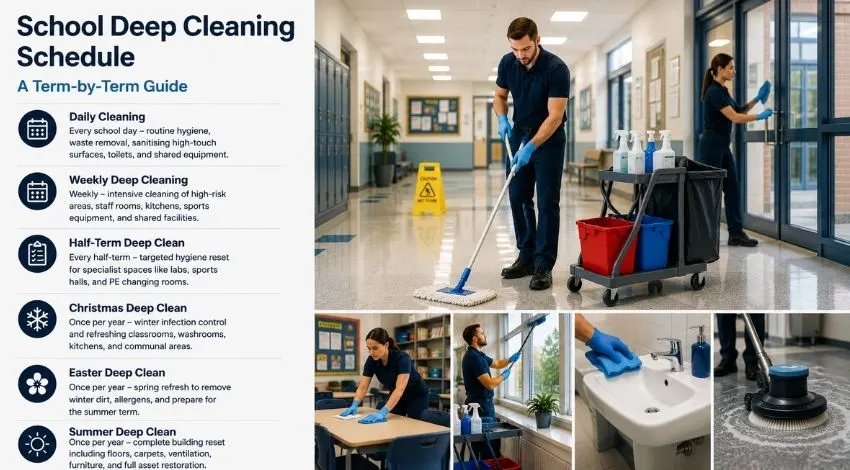
Each deep clean is timed to happen during the holiday before the next term starts, so the building is ready before pupils and staff walk back in.
Daily Cleaning (Every School Day)
Daily cleaning is the foundation of an effective school cleaning schedule, helping to maintain a clean, safe, and hygienic environment for pupils, staff, and visitors.
It focuses on routine tasks such as emptying bins, vacuuming and mopping floors, cleaning classrooms, sanitising desks and tables, disinfecting high-touch surfaces, cleaning toilets and washrooms, and restocking essential hygiene supplies. Consistent daily cleaning helps reduce the spread of germs while preventing dirt and clutter from building up between scheduled deep cleans.
Weekly Deep Cleaning
Weekly deep cleaning goes beyond routine daily maintenance by focusing on high-traffic and high-touch areas that require more thorough attention. This includes staff rooms, kitchens, dining halls, sports equipment, shared computers and ICT devices, door handles, handrails, and communal spaces.
By removing built-up dirt, bacteria, and grime from frequently used areas, weekly deep cleaning helps maintain high hygiene standards and keeps the school environment cleaner between termly and annual deep cleans.
Half-Term Mini Deep Cleans
Half-terms are too short for a full deep clean, but they’re a useful checkpoint. A targeted mini deep clean focusing on toilets, PE changing rooms, canteens, and any areas showing signs of wear helps keep the building on track between the bigger seasonal cleans, rather than letting six or seven weeks of daily use build up unchecked.
Autumn Term Deep Clean
Carried out over the summer holidays, this is usually the biggest deep clean of the year. With six weeks of the building largely empty, it’s the best opportunity for jobs that take time and disrupt normal use, such as stripping and resealing hard floors; deep cleaning carpets throughout classrooms and corridors; and giving halls, gyms, and communal areas proper attention after a full year of wear.
It’s also the point to deal with anything that’s built up unnoticed dust in ventilation systems, grime behind fixed furniture, and marks or scuffs that daily cleaning never quite reaches. Getting this right means classrooms are genuinely ready for September, not just tidied up the week before term starts.
Spring Term Deep Clean
Carried out over the Christmas break, this clean is less about resetting the whole building and more about infection control. Cold and flu season peaks over winter, and primary schools in particular tend to see a run of illness passing through classrooms in the lead-up to Christmas.
A thorough clean over the holidays with real focus on toilets, washrooms, door handles, and shared equipment helps the school start January without carrying that illness straight into the new term. This is also a sensible point to check carpets and soft furnishings, since heating being on constantly through winter tends to make dust and allergens worse.
Summer Term Deep Clean
Carried out over the Easter break, this clean bridges the gap before the busiest stretch of the school year. With exam season, sports days, and end-of-year events all landing in the summer term, it’s worth checking ventilation is working properly, carpets and high-touch surfaces are holding up, and PE changing rooms and sports halls are properly cleaned before they see heavier use.
It’s a shorter break than summer, so this clean tends to focus on the areas that need it most rather than a full facility-wide treatment, but it still matters. Skipping it often means starting the busiest term with a building that’s already behind.
Recommended Read: DBS Checks for School Cleaning
What's Included in a School Deep Clean?
A proper deep clean covers every part of the school, not just the obvious areas. A typical deep clean includes:
- Classrooms and communal areas: floors stripped and resealed where needed, furniture cleaned and repositioned, and surfaces properly disinfected rather than just wiped over
- Toilets, washrooms, and high-touch surfaces: full descaling of taps and cubicles, door handles, light switches, and anywhere hands make contact throughout the day
- Kitchens and dining halls: appliances, worktops, and food prep areas cleaned to food hygiene standards, with particular attention to areas routine cleaning can’t reach behind equipment
- Carpets, upholstery, and air vents: carpets steam-cleaned to lift ground-in dirt and allergens, with ventilation units serviced to keep air quality up throughout the building
Reputable contractors use colour-coded equipment for these areas, keeping kitchen and toilet cleaning strictly separate to avoid cross-contamination – a small detail, but one that matters in a building full of children.
School Areas That Need the Most Frequent Attention
| Area | Cleaning Priority |
|---|---|
| Toilets | Daily |
| Dining Hall | Daily |
| Door Handles | Daily |
| Science Labs | Weekly |
| Nursery Toys | Daily |
| Sports Hall | Weekly |
| Staff Room | Weekly |
| Air Vents | Termly |
See what school cleaning services actually cover from daily upkeep to full facility deep cleans, all in one guide.
Signs Your School Needs a Deep Clean Sooner
Sometimes a school can’t wait for its scheduled clean. A few signs mean it’s worth bringing the deep clean forward rather than sticking to the calendar:
- A rise in illness or absence rates among pupils and staff: if colds, stomach bugs, or flu keep circulating longer than usual, it’s often a sign that surfaces and shared equipment need more than daily cleaning can manage
- Visible grime, lingering odours, or allergen buildup in classrooms and washrooms: smells that don’t clear even after routine cleaning, or dust and marks building up despite daily attention, usually point to carpets, vents, or soft furnishings needing proper treatment
- After building work, flooding, or an outbreak such as norovirus: these situations bring dust, contamination, or bacteria that daily cleaning simply isn’t designed to deal with, and waiting for the next scheduled deep clean isn’t practical or safe
If any of these show up before your next planned deep clean, it’s worth bringing the schedule forward rather than waiting it out. A quick conversation with your cleaning contractor is usually enough to arrange this without much notice.
Benefits of Having a Structured School Deep Cleaning Schedule
A structured deep cleaning schedule isn’t just about cleanliness it’s about running the school’s facilities with less guesswork and fewer last-minute problems.
Schools that plan deep cleaning properly tend to notice the following:
- Predictable workload planning: facilities team knows what’s happening and when, instead of scrambling to arrange cover during term time
- Better budget control: aligning your deep cleaning schedule with typical school cleaning costs in the UK reduce the need for emergency call-outs and unbudgeted costs
- Clear accountability: defined cleaning cycles set out exactly what’s expected, and when, across staff and contractors
- Early warning on maintenance issues: regular deep cleans often surface wear, damage, or problems before they turn into a bigger repair
- Full use of holiday access: with the building empty, cleaning can be thorough and unrestricted, rather than worked around timetables
- Ready compliance evidence: a documented, consistent schedule is easy to produce for audits, governors, or internal reviews
The real benefit is moving from reactive cleaning, sorting problems as they come up, to a planned system that keeps the building, budget, and compliance record all under control.
Want the same structure and control for your school? See how Gurkha Cleaning Ltd builds structured deep cleaning schedules for schools across Hampshire.
Why Choose Gurkha Cleaning Ltd for Your School Deep Clean?
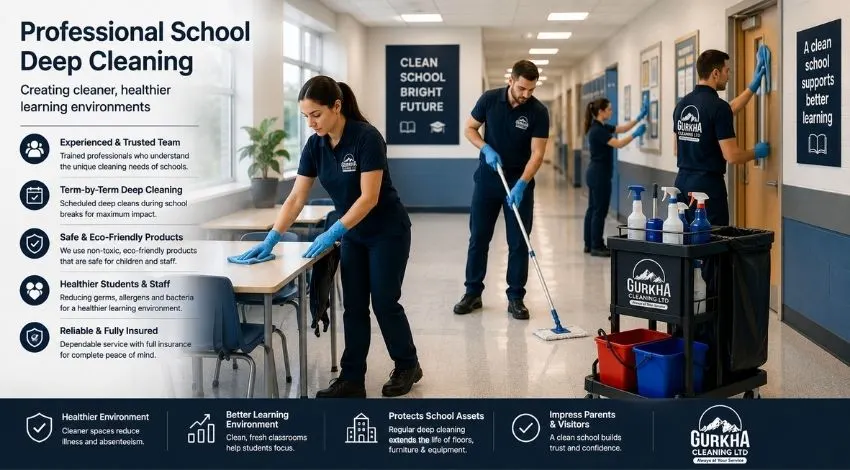
Gurkha Cleaning Ltd is a Hampshire-based commercial cleaning company trusted by schools across the region. We understand what a school deep clean actually needs to cover the safeguarding requirements, the tight holiday windows, the compliance obligations, and the importance of getting it right before term starts, not scrambling the week before.
Here’s what sets us apart:
- CHAS accredited and BICSC certified: meeting the accreditation standards most schools require from contracted suppliers, with enhanced DBS checks for every operator before they set foot on a school site
- Term-by-term scheduling: deep cleans planned around your school calendar, whether that’s summer, Christmas, Easter, or a half-term mini clean
- COSHH-compliant products: safe for use around children, correctly stored, and handled by trained staff
- Emergency response capability: rapid deep clean protocols for illness outbreaks, flooding, or building work
- Experience across Hampshire schools: primary, secondary, sixth forms, and independent schools across Winchester, Southampton, Basingstoke, Aldershot, Farnham, Petersfield, Andover, Salisbury, Newbury, Portsmouth, and Alton
- Transparent pricing: no hidden costs, no vague estimates; school budgets are tight and we respect that
Whether you need a single seasonal deep clean, a full term-by-term schedule, or a combined programme alongside your daily and weekly cleaning, we build it around your school, not a standard template.
Final Thoughts
Getting the frequency right isn’t complicated once it’s mapped against the school calendar. Two to three full deep cleans a year, timed around the summer, Christmas, and Easter breaks, cover most schools well with half-term mini cleans and daily and weekly upkeep filling the gaps in between. Larger schools, nurseries, and settings with higher footfall may need to lean towards a termly schedule rather than stretching to one annual clean.
What matters most is treating deep cleaning as something planned, not something reactive. A school that waits for illness to spread, complaints to build up, or an inspection to catch it out is always working from behind. A structured schedule, mapped against term dates, means the work happens on your terms and never disrupts a single lesson.
If your current schedule feels patchy, or you’re not sure it’s keeping pace with your school’s size and footfall, it’s worth reviewing against the school year rather than waiting for a problem to force the decision.
Ready to sort a proper deep cleaning schedule for your school? Contact Gurkha Cleaning Ltd today, and we’ll map it out around your school, not a generic template.
FAQs
How often should schools be deep cleaned?
Most schools need a full deep clean 2 to 3 times a year, usually during the summer, Christmas, and Easter breaks. This sits alongside regular weekly and daily cleaning.
What's the difference between deep cleaning and regular cleaning?
Regular cleaning covers daily upkeep like floors and surfaces. Deep cleaning reaches further into carpets, vents, and areas that need the building to be empty to access properly.
Do schools need to deep clean every holiday?
Not always. Many schools deep clean every term, but smaller schools with strong daily routines can sometimes manage with one annual deep clean over summer.
How much does a school deep clean cost?
Deep cleans for schools typically cost around £2–£4 per m², though this varies by size and areas covered. Get in touch for a walk-through quote based on your building.
Can deep cleaning happen during term time?
It’s not ideal. Deep cleans work best with the building empty, so most schools schedule them for holidays and half-terms.
How long does a school deep clean take?
This depends on the size of the school and areas covered, but most full deep cleans are completed within a few days during the holidays. Larger sites or more extensive scopes may take longer.
Should schools be deep cleaned after a virus outbreak?
This targets searches around outbreaks of flu, norovirus, and similar illnesses and broadens your topical coverage.