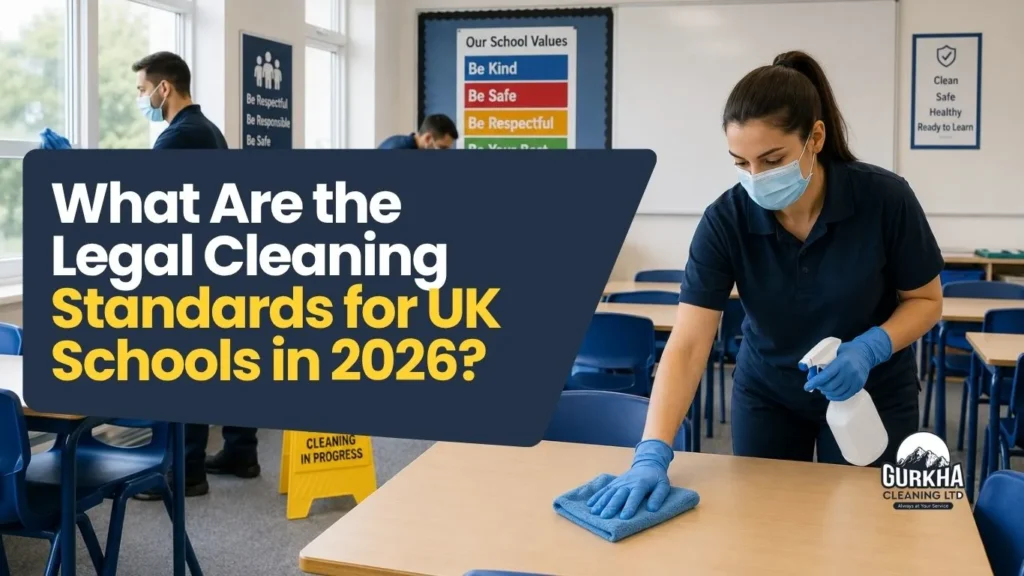
UK schools must meet legal cleaning standards set out under the School Premises Regulations 2012, COSHH regulations, DfE guidance, and UKHSA infection control advice covering everything from washroom hygiene to staff vetting for anyone working on site.
If you’re a business manager, headteacher, or premises lead in Hampshire, you’ll know that school cleaning standards in UK wide aren’t optional extras; they’re a legal responsibility. If you’re new to procurement or reviewing your current setup, it’s worth first understanding what school cleaning services are before assessing whether your provider meets the standards below.
This guide sets out the school cleaning legal requirements for 2026 schools need to know, from the regulations that govern premises to the practical schedules that keep classrooms, washrooms, and canteens fit for children every single day.
School Cleaning Standards in UK at a Glance
- UK schools must comply with the School Premises Regulations 2012, the Workplace (Health, Safety and Welfare) Regulations 1992, and non-statutory DfE guidance.
- All cleaning chemicals must meet COSHH regulations correctly labelled, securely stored, and matched to data sheets.
- Washrooms must be checked and cleaned at least 2–3 times a day, rising to twice daily during illness outbreaks (per UKHSA guidance).
- Any cleaner with unsupervised site access, including outsourced staff, must hold an Enhanced DBS check.
- Legal responsibility sits with the governing body or trust, even when cleaning is outsourced.
- Ofsted doesn’t inspect cleaning directly but factors the premises’ condition into leadership judgements; the HSE enforces health and safety breaches separately.
- Non-compliance risks include Ofsted judgement impact, HSE enforcement, insurance exposure, and reputational damage.
What Laws Govern School Cleaning Standards in the UK?
School cleaning standards in UK wide are set out primarily through the School Premises Regulations 2012, the Workplace (Health, Safety and Welfare) Regulations 1992, and non-statutory DfE guidance built on top of them. There isn’t one single law that says “Schools must be cleaned to X standard”; instead, several pieces of legislation work together to set the bar.
School Premises Regulations 2012
The School Premises Regulations 2012 require that school premises and everything provided within them be maintained to a standard that ensures the health, safety, and welfare of pupils, so far as is reasonably practicable. This covers toilets, washing facilities, drinking water, lighting, and general upkeep of the building.
Workplace (Health, Safety and Welfare) Regulations 1992
Sitting alongside this is the Workplace (Health, Safety and Welfare) Regulations 1992, which apply to schools as workplaces the same standards that underpin commercial cleaning requirements across offices, retail, and other business premises and cover cleanliness, ventilation, and general condition of premises for staff as well as pupils.
DfE Cleaning Standards Guidance
The DfE cleaning standards schools are expected to follow build on this legal base. The Department for Education publishes non-statutory advice on premises standards, and it’s this advice, alongside the underlying regulations, that most schools use to shape their day-to-day cleaning specification.
Together, these form the backbone of health and safety regulations for schools in the UK wide, and they apply whether you’re a single-form-entry primary in Alton or a large secondary academy in Basingstoke.
COSHH Regulations: What Schools Must Get Right
COSHH regulations schools must follow require that every hazardous substance used on site is identified, correctly labelled, and stored securely, usually in a locked, well-ventilated cupboard away from areas pupils can access. Cleaning products are chemicals, and chemicals around children need careful handling, and getting the basics wrong is easier than most schools realise.
In practice, getting it right means:
- Every product used matches its COSHH data sheet, with staff trained on what it’s for and how to use it safely.
- Chemicals are never left out on trolleys or in unlocked classrooms during the school day.
- Dilution rates and contact times are followed exactly, not estimated.
Getting this wrong isn’t just a paperwork issue; unlabelled or unsecured chemicals are one of the first things a health and safety inspector or an Ofsted visit will flag, and it’s an easy gap to close with the right storage and training in place.
Ready to Give Your Students a Cleaner, Healthier Learning Environment?
From daily classroom cleaning to holiday deep cleans, Gurkha Cleaning Ltd provides reliable, DBS-checked education cleaning services tailored to your school’s needs. Get Your Free Education Cleaning Quote
Toilets & Washroom Rules Schools Must Meet
School toilet and washroom regulations under the School Premises Regulations 2012 set clear minimum standards for every school site covering separate facilities, water supply, and upkeep throughout the day. Washrooms are one of the areas Ofsted and parents notice fastest and one of the most closely regulated:
- Separate toilet facilities are required for boys and girls aged eight and over, unless the facility is a single, lockable room.
- Washing facilities must have an adequate supply of hot and cold water, along with soap and a means of drying hands.
- Changing accommodation and showers must be provided for pupils aged 11 and over who take part in PE.
- Facilities must be kept clean, well-ventilated, and in good working order at all times the school is in use.
In practice, that means washrooms need checking and cleaning several times across the school day, not just once before the first bell. Worn or grubby facilities are one of the fastest ways a school’s overall standards get called into question.
Staff Vetting & Safeguarding: DBS Checks for School Cleaners
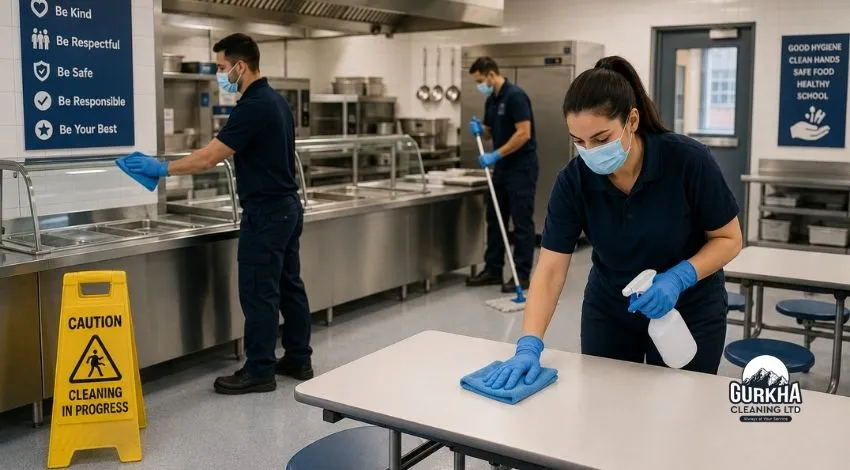
DBS checks for school cleaners are required at the enhanced level, the same level expected of most staff who have regular, unsupervised access to a school site. Anyone working on site during term time, including outsourced cleaning staff, is working around children, and safeguarding rules reflect that.
For schools, this means:
- Any outsourced cleaning company should be able to provide evidence of enhanced DBS checks for every member of staff sent to the site, not just supervisors.
- Cleaners working during term time, particularly where pupils may still be on site, should be briefed on the school’s safeguarding-first working practices.
- Records should be kept up to date and available for inspection by the school or MAT at any time.
Note: Gurkha Cleaning Ltd teams are fully DBS-checked and vetted before they’re placed at any school, and we can provide documentation as part of procurement or tender processes.
Who Is Responsible for School Cleaning Standards in the UK?
Legally, the answer to who is responsible for school cleaning standards is the school’s governing body or, for academies, the trust, with day-to-day responsibility usually delegated to the head teacher or business manager. Where cleaning is outsourced, the school remains accountable for making sure the contractor meets agreed standards; the contract doesn’t transfer the legal duty.
Accountability: Governing Body, Trust, and School Leadership
Responsibility sits at governor or trustee level by law, but in practice it’s the headteacher or business manager who owns the day-to-day standard on site. This is why it’s worth building clear key performance indicators into any cleaning contract and reviewing them regularly rather than assuming standards are being met.
Ofsted School Cleaning Requirements
Ofsted school cleaning requirements aren’t a standalone checklist, but inspectors do form judgements about leadership and management partly from the condition of the building. Grubby washrooms, overflowing bins, or a canteen that doesn’t look properly maintained can raise questions about wider oversight even where teaching is strong.
Infection Control: UKHSA Guidance for Schools in UK
UKHSA infection control guidance sets out how schools should clean day-to-day and how to respond when illness is going round. It covers everything from routine surface cleaning to how spillages and outbreaks should be handled.
High-Touch Surfaces: Routine vs. Outbreak Cleaning
Door handles, light switches, taps, and keyboards need regular attention as part of everyday cleaning. During an outbreak of norovirus, flu, or similar illness, UKHSA guidance recommends stepping this up to twice-daily cleaning of these contact points until the outbreak has passed.
If your school has dealt with a nit outbreak, a bout of norovirus mid-term, or the flu sweeping through a year group, you’ll know how much this matters in practice and how quickly a good cleaning response can bring things back under control.
Body Fluid Spillages: What Staff Must Do
Spillages of blood, vomit, urine, or faeces need to be dealt with immediately, not left until the next scheduled clean:
- Wear appropriate PPE before starting.
- Use a combined detergent and disinfectant product, not detergent alone.
- Dispose of waste in a double-bagged, securely sealed bin liner.
- Never use a mop for bodily fluids; disposable paper towels or a dedicated spillage kit is the correct approach.
- Keep equipment colour-coded so items used in washrooms never cross over into kitchens or classrooms, and vice versa; it’s one of the simplest ways to stop cross-contamination between zones.
Getting infection control right isn’t about reacting to one bad week; it’s about routine cleaning being solid enough that an outbreak, when it happens, is a step up rather than a scramble.
How Often Should Schools Be Cleaned in the UK?
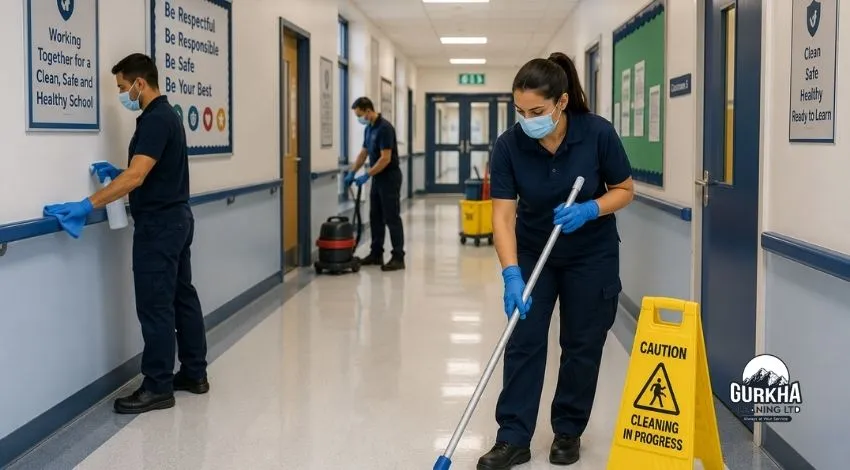
Schools need cleaning every day during term time, with more intensive deep cleans carried out during half-terms and summer holidays. Meeting school cleaning schedule requirements means having a structured plan that covers daily, weekly, and periodic tasks, not an ad hoc approach that varies by who’s on shift.
Daily, term-time cleaning typically covers:
- Emptying bins across classrooms, corridors, staff rooms, and offices
- Wiping down desks, door handles, and other high-touch surfaces
- Vacuuming carpets and mopping hard floors
- Fully sanitising washrooms, including toilets, sinks, and floors
- Kitchen and canteen cleaning in line with food hygiene standards, particularly around allergen control
Periodic deep cleans, usually scheduled for half-terms and summer holidays, cover the jobs that can’t happen while pupils are in the building: carpet extraction, floor scrubbing and resealing, high-level dusting, and a full reset of areas like science labs, sports halls, and PE changing rooms. Exam hall turnarounds and post-renovation cleans tend to fall into this category too, work timed around the school calendar, not squeezed in during lesson time.
A schedule on paper is only useful if it’s actually being followed, which is where a proper compliance check comes in.
Recommended Read: How often should schools be deep cleaned?
School Cleaning Compliance Checklist for UK Schools
Checking your current provision against a clear school cleaning compliance checklist is the fastest way to spot gaps before an inspection or a governor’s question does it for you:
- Is there a written schedule covering daily, weekly, and periodic tasks for every area of the site?
- Are washrooms checked and topped up more than once a day?
- Is there a documented process for spillages and outbreak response?
- Are COSHH data sheets available for every product in use?
- Can the contractor evidence Enhanced DBS checks for all staff on site?
- Is cleaning scheduled around timetables, staggered access, and holiday periods rather than disrupting lessons?
If you can’t answer ‘yes’ to all of these, it’s worth a closer look at your current arrangements, whether that’s an in-house team or an outsourced contract.
Recommended Read: School Cleaning Costs in the UK
What Happens If a UK School Doesn't Meet Cleaning Standards?
Falling short isn’t just a compliance technicality; it carries real consequences, and they tend to surface at the worst possible moment:
- Ofsted: poor premises condition feeds into judgements about leadership and management, even where teaching is strong.
- HSE enforcement: the Health and Safety Executive can issue improvement notices and, in serious cases, pursue prosecution for COSHH breaches or unsafe conditions.
- Insurance and liability: incorrect chemical storage or a missing An enhanced DBS check leaves the school exposed, both on cover and on the governing body’s duty of care.
- Reputation: a visible hygiene issue is remembered by parents and governors long after it’s fixed.
This is why the checklist above is worth acting on now, rather than after something’s already gone wrong.
Why Choose Gurkha Cleaning Ltd for School Cleaning in Hampshire
Gurkha Cleaning Ltd provides outsourced school cleaning services UK wide, with dedicated coverage across Hampshire:
- Coverage: primary schools, secondary schools, academies, MATs, and independent schools across Winchester, Southampton, Portsmouth, Basingstoke, Aldershot, Farnham, Andover, Salisbury, Petersfield, Newbury, and Alton.
- Accreditation: BICSC Corporate Member, CHAS-accredited, and ISO certified
- Standards: fully insured, DBS-checked staff working to COSHH-compliant standards throughout
- Trust: read what schools and businesses we work with have to say in our client testimonials.
If you’re weighing up outsourced school cleaning services UK wide and want a straight conversation about what a compliant, dependable schedule looks like for your site, get in touch. We’re happy to talk through your specific term dates, budget, and procurement process.
Need a trusted school cleaning contractor? Contact Gurkha Cleaning Ltd today to discuss your requirements or request a free, no-obligation quote.
Final Thoughts
School cleaning standards in the UK sit on real legislation and guidance: the School Premises Regulations 2012, COSHH, UKHSA infection control advice, and safeguarding requirements around DBS checks all combine to set a clear bar. Meeting it isn’t about box-ticking; it’s about a building that’s genuinely safe and hygienic for pupils and staff, day in, day out.
The most useful thing you can do this term is measure your current cleaning provision against the checklist above. If there are gaps in scheduling, in documentation, or in how spillages and outbreaks are handled, they’re worth raising now, before an inspection or a governor’s question puts them under the spotlight.
Looking for a trusted commercial cleaning company for schools and nurseries in Hampshire? Visit Gurkha Cleaning Ltd to learn more about our services and discover how we help schools and businesses maintain high hygiene standards.
FAQs
What are the legal cleaning standards for UK schools?
The legal cleaning standards for UK schools are to maintain clean, safe, and hygienic premises in compliance with the Health and Safety at Work etc. Act 1974 and the School Premises (England) Regulations 2012.
Do schools have to use DBS-checked cleaning staff?
Yes, schools should use DBS-checked cleaning staff if they work regularly in school premises or may have unsupervised access to children, in line with UK safeguarding requirements.
How often should washrooms be cleaned in a school?
School washrooms should be cleaned at least once daily, with more frequent cleaning during the day in high-traffic schools or when needed to maintain hygiene.
Who checks that a school meets cleaning standards?
School cleaning standards are typically monitored by the school leadership, local authorities or academy trusts and inspected by Ofsted as part of overall health, safety, and safeguarding standards.
What's the difference between daily cleaning and a deep clean?
Daily cleaning removes everyday dirt, dust, and germs from frequently used areas, while deep cleaning thoroughly sanitises hard-to-reach and high-touch areas using more intensive cleaning methods.
Should schools outsource cleaning or keep it in-house?
It depends on the school’s needs. Outsourcing offers professional expertise and flexibility, while in-house cleaning provides greater control over staff and cleaning schedules.