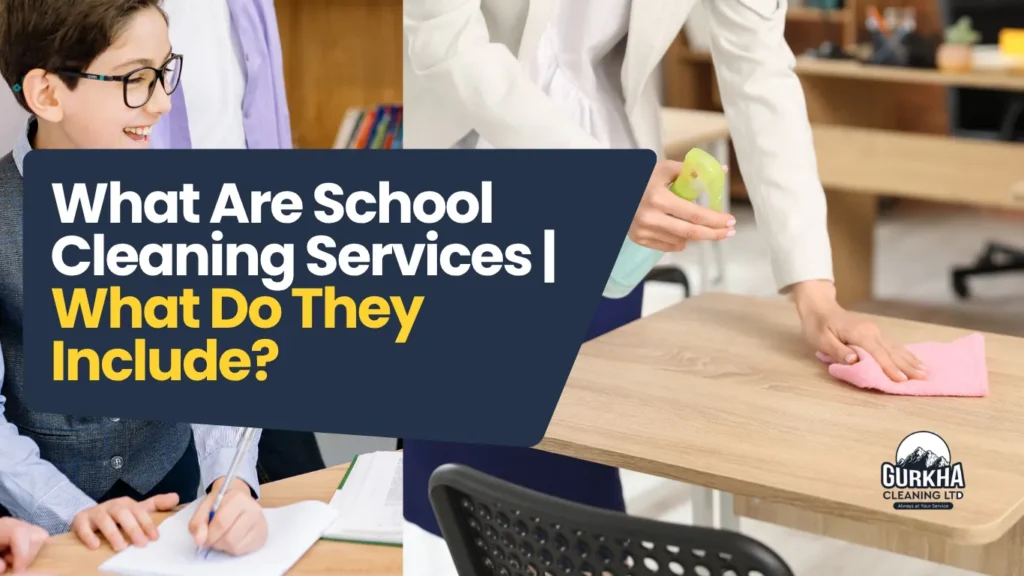
School cleaning is not the same as cleaning an office, a retail unit, or a commercial building. The stakes are different. The people inside are children. The regulatory expectations are higher. And the consequences of getting it wrong – illness outbreaks, safeguarding failures, and a poor Ofsted premises report – fall directly on the head teacher, the site manager, and the leadership team.
This guide explains what professional school cleaning services actually cover, what a good provider looks like, and what Hampshire school decision-makers should expect when appointing a cleaning company.
Quick Overview
Short on time? Here is what you need to know:
- School cleaning is specialist work built around child safety, safeguarding, and infection control, not standard commercial cleaning
- A full contract covers daily classroom cleaning, toilet sanitation, high-touch surface disinfection, and holiday deep cleans
- All staff must hold enhanced DBS checks – a safeguarding requirement, not a formality
- A credible provider holds CHAS accreditation, BICSC certification, and full public liability insurance
- All cleaning is scheduled outside school hours so learning is never disrupted
What Are School Cleaning Services?
School cleaning services are specialist commercial cleaning solutions designed specifically for educational facilities from early years and primary schools through to secondary schools, sixth forms, and independent schools.
Unlike standard commercial cleaning, school cleaning is built around child safety, safeguarding, and infection control. As with any organisation, professional commercial cleaning is not optional when the health of children is involved.
- Staff undergo enhanced DBS checks as a baseline requirement, not an optional extra
- Cleaning protocols are built around infection control, not just surface appearance
- Products and procedures must comply with COSHH regulations safe for use around children and in food preparation areas
- All work is scheduled outside school hours before children arrive (typically from 6am) and after they leave (from 4pm onward), so cleaning never disrupts learning
- Schedules align with the school calendar’s term-time routines, holiday deep cleans, and emergency response capability
Whether you manage a 200-pupil primary in Winchester, a large secondary in Southampton, or an independent school in Farnham, the fundamentals of what good school cleaning covers remain the same.
Planning your next holiday deep clean? Explore our school cleaning services and find the right fit for your school.
What Do School Cleaning Services Include?
| Service Level | Core Focus Areas | Common Frequency | Key Regulations |
|---|---|---|---|
| Daily Routine | Classrooms, corridors, high-traffic toilets, waste removal, consumable replenishment. | Every evening / early morning | Health & Safety at Work Act 1974 |
| Specialist Zones | Science labs, IT suites, food tech rooms, sports changing facilities. | Daily to weekly variation | COSHH / Food Hygiene Standards |
| Periodic Deep Clean | Hard floor stripping/sealing, carpet extraction, high-level dusting, full tile descaling. | Major school holidays (3x year) | The Education (School Premises) Regulations 1999 |
Daily Routine Cleaning
Daily school cleaning covers the consistent, scheduled tasks that keep classrooms, corridors, and shared spaces safe and functional throughout the term.
This typically includes:
- Vacuuming carpeted areas and mopping hard floors in classrooms, hallways, and reception areas
- Emptying and relining bins across all areas, including classrooms, staff rooms, and offices
- Dusting surfaces, window ledges, and skirting boards
- Cleaning glass panels in doors and entrance areas
- Replenishing consumables hand soap, paper towels, toilet rolls before school starts
In a primary school with 30 children per classroom, floors and surfaces take real punishment every day. Daily cleaning is not aesthetic; it directly reduces the transmission of bacteria and viruses between children.
Want to understand the process behind daily cleaning? Read our guide on the 7 stages of cleaning.
High-Touch Surface Sanitisation
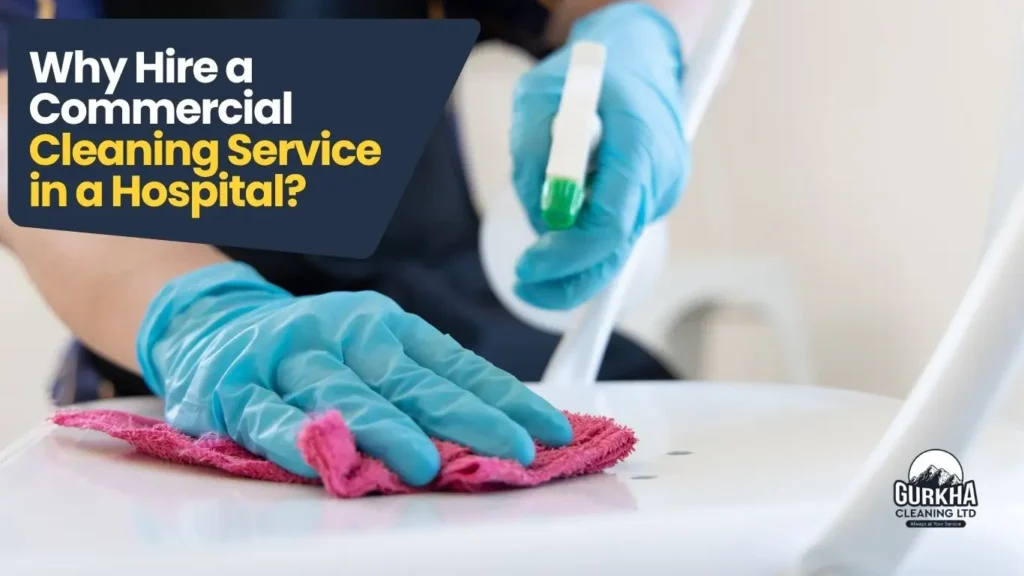
High-touch surface sanitisation is one of the most infection-critical parts of any school cleaning checklist. High-contact points accumulate bacteria and viruses quickly, particularly during cold and flu season.
High-touch sanitisation should cover:
- Door handles and push plates on every door
- Light switches in classrooms, corridors, toilets, and staff areas
- Handrails on stairways
- Shared student desks and chairs
- Keyboard and mouse surfaces in computer suites
- Taps and sink surrounds in classrooms and science labs
- Reception desks and sign-in screens
During illness outbreaks of norovirus, flu, or anything that spreads rapidly through a school, the frequency of high-touch sanitisation should increase significantly. A professional school cleaning company will have clear escalation protocols for exactly these situations.
Classroom Cleaning Services
Classrooms are the core of any school cleaning operation. Each room is used by up to 30 children for the full school day, five days a week, and must be reset to a clean, safe standard every evening.
Classroom cleaning services include:
- Full floor clean: vacuum or mop depending on floor type
- Desk and chair sanitisation
- Display board dusting and maintenance
- Window ledge and radiator cover dusting
- Bin emptying and lining
- Spot-cleaning of walls and doors as needed
In early years and Reception classrooms, additional attention is required for low-level surfaces, soft furnishings, and play equipment that children handle constantly.
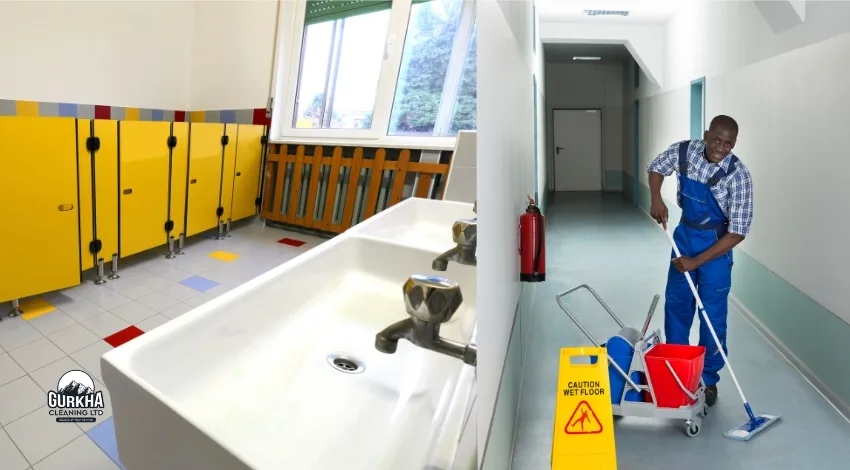
School Toilet Cleaning
School toilet cleaning is one of the most important and most demanding elements of a school cleaning contract. Toilet blocks are high-traffic, high-risk hygiene environments, and the standard of cleaning here directly affects infection control across the whole school.
A proper toilet cleaning protocol covers:
- Full scrubbing and disinfection of toilet pans, seats, and cisterns
- Basin, tap, and mirror cleaning and disinfection
- Floor mopping with disinfectant including around urinals and cubicle bases
- Restocking of soap, hand towels, and toilet paper
- Sanitary disposal unit servicing where relevant
- Grout and tile descaling as part of periodic deep cleans
Inadequate toilet hygiene is one of the fastest routes to illness spread in schools. It is not an area where any corners should be cut.
Specialist Area Cleaning
Schools contain areas that require specific cleaning knowledge beyond standard janitorial work. A competent school cleaning company will have staff trained to handle:
- Science laboratories: Chemical residue, equipment contamination, and COSHH compliance around cleaning products used in proximity to lab chemicals
- Food technology rooms and kitchens: Allergen removal protocols matter here. Nut-free areas require specific procedures. Food preparation surfaces must meet food hygiene standards, not just general cleanliness
- Computer suites: Antistatic considerations, careful handling of screens and keyboards, and appropriate product use to avoid damage
- Sports halls and changing rooms: High-traffic flooring, shower areas, lockers, and benches plus body fluid protocols for sports injuries
- Cafeterias and lunch halls: Post-lunch food residue removal, table and bench sanitisation, and floor cleaning to food hygiene standards
Each area has its own risk profile. A good provider will have written procedures for each, not a one-size-fits-all approach.
School Deep Cleaning
School deep cleaning is the comprehensive, intensive sanitisation typically carried out during school holidays: Easter, summer, and Christmas breaks. This is when areas that cannot be fully addressed during term time receive proper attention.
School deep cleaning typically includes:
- Floor-to-ceiling cleaning of all classrooms, corridors, and common areas
- Carpet washing and extraction, removing the term’s worth of embedded dirt and bacteria
- Floor stripping, resealing, and polishing on hard floor surfaces
- Internal window cleaning
- Deep clean of all toilet blocks and changing rooms
- Kitchen and food prep area deep sanitisation
- Specialist cleaning of science labs, IT suites, and sports facilities
- Furniture moving and cleaning beneath and behind fixed items
For school site managers across Hampshire, whether in Basingstoke, Andover, Aldershot, or Alton, the summer deep clean is a critical reset before the next academic year begins. It is also an opportunity to address any areas that have deteriorated during the term.
How Does School Cleaning Control the Spread of Infection?
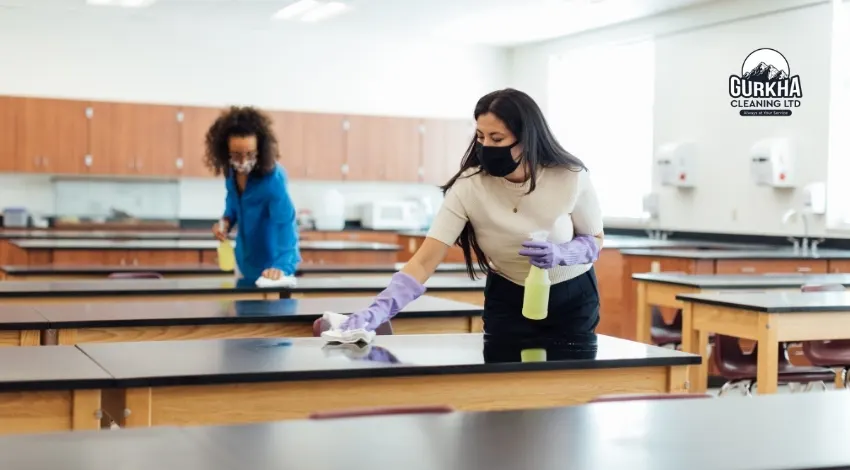
Infection control in schools is not just good practice; it is a duty of care. Schools are environments where illness spreads quickly. One norovirus case can become a school-wide outbreak within 48 hours.
Good infection control comes down to five things: the right products, the right equipment, documented processes, trained staff, and a clear plan for when illness hits.
- COSHH-compliant disinfectants: products that are effective against bacteria and viruses, safe around children, and used at the correct dilution and contact time
- Colour-coded equipment: separate mops, cloths, and buckets for different areas (toilets, kitchens, classrooms) to prevent cross-contamination
- Documented cleaning schedules: written records that can be checked by Ofsted or the local authority
- Emergency outbreak response: the ability to carry out a rapid deep clean of affected areas when illness hits
- Staff training: cleaning operatives who understand the difference between cleaning (removing dirt) and disinfecting (killing pathogens)
Schools that experience regular illness-related absence often find that their cleaning protocols are part of the problem. A properly structured commercial school cleaning programme reduces transmission and the number of school days lost as a result.
What UK Regulations Govern School Hygiene and Cleaning Standards?
School hygiene regulations in the UK are governed by a combination of legislation and statutory guidance. Understanding which frameworks apply and what they require is essential for any school appointing a cleaning provider.
The most relevant frameworks include:
- Health & Safety at Work Act 1974: places a legal duty on employers (including schools) to maintain safe premises for staff and visitors. Adequate cleaning is part of that duty
- COSHH Regulations 2002: require that any hazardous substances used in cleaning be properly assessed, stored, and handled. Cleaning staff must be trained and records must be kept
- Education (School Premises) Regulations 1999: set minimum standards for the condition and hygiene of school premises, including toilets, washrooms, and food-preparation areas
- Ofsted inspections: while Ofsted does not audit cleaning schedules directly, inspectors assess the overall condition and safety of school premises. A poorly maintained environment will be noted
- DfE guidance on health and safety: includes specific reference to the importance of cleanliness in managing infectious disease in educational settings
Meeting school cleaning standards UK-wide requires a provider who understands these frameworks and can demonstrate compliance, not just describe it.
Recommended Read: School Cleaning Standards in UK
Why Do School Cleaners Need Enhanced DBS Checks?
Enhanced DBS checks are a safeguarding requirement for anyone working regularly in a school, not an optional extra or an administrative formality.
DBS checked school cleaners are vetted to confirm they have no convictions or cautions that would make them unsuitable to work around children. Enhanced checks also include a check of the barred lists, the register of individuals legally prohibited from working with children.
These are not unreasonable questions to ask; a credible provider will have clear, documented answers to all of them. When appointing a school cleaning company, ask specifically:
- Are all operatives enhanced DBS checked before they start work on school sites?
- Is this renewed regularly, or is it a one-time check?
- What happens if a cleaner’s circumstances change?
- Who is responsible for maintaining DBS records?
Any provider who is vague about their DBS procedures should not be on your shortlist.
Recommended Read: DBS Check for school cleaners
What Should You Ask Before Appointing a School Cleaning Company?
Before appointing a school cleaning company, ask about their operating hours, holiday deep clean capability, emergency response procedures, compliance documentation, and school references.
Accreditations confirm compliance. These questions confirm fit, whether a provider can actually operate around a school’s daily routine and respond when things go wrong.
Ask specifically:
- Can they start before 7:30am and finish after 4pm without disrupting school hours?
- Do they have a holiday deep clean schedule that aligns with your school calendar?
- Can they respond quickly to illness outbreaks or accident cleanups?
- Do they provide written cleaning schedules and sign-off records for Ofsted purposes?
- Can they provide references from schools of a similar type and size to yours?
For primary schools in Winchester or Southampton and secondary schools in Farnham or Petersfield, the answers to these questions matter as much as price.
What Type of School Cleaning Do You Need?
The right cleaning programme depends on your school’s specific situation. Three things determine what you need:
Type of facility
Early years and primary schools have different requirements to secondary schools. A nursery has different surface and product requirements to a sixth form with science labs. A school with a large commercial kitchen has different food hygiene and cleaning needs than a small primary school with a servery.
Term-time or holiday, or both
Many schools separate their term-time daily cleaning contract from their holiday deep clean requirement. Some prefer a single provider for both. Either model can work; what matters is that both are properly resourced and scheduled.
Recommended Read: How often should schools be deep cleaned
Specialist areas
If your school has a large sports centre, multiple science labs, a food technology suite, or extensive outdoor facilities, make sure any prospective provider has specific experience with those areas and references to prove it.
Schools across Hampshire from Aldershot schools with larger site footprints to the smaller independent schools around Petersfield and Alton will have different needs. The cleaning programme should be built around your school, not a standard template. When planning your annual budget, read our detailed guide on school cleaning costs in the UK.
Why Choose Gurkha Cleaning Ltd for Your Schools?
Gurkha Cleaning Ltd is a Hampshire-based commercial cleaning company trusted by schools across Winchester, Southampton, Basingstoke, Aldershot, Farnham, and Petersfield. We understand the specific demands of school environments: the safeguarding requirements, the tight scheduling, the compliance obligations, and the importance of getting it right every single day.
Here is what sets us apart:
- CHAS accredited and BICSC certified: meeting the accreditation standards most schools require from contracted suppliers, with enhanced DBS checks for every operator before they set foot on a school site
- School-aligned scheduling: early morning starts, late finishes, and holiday deep cleans built around your school calendar
- COSHH-compliant products: safe for use around children, correctly stored, and handled by trained staff
- Emergency response capability: rapid deep clean protocols for illness outbreaks, accidents, and urgent situations
- Experience across Hampshire schools: primary, secondary, sixth forms, and independent schools across Winchester, Southampton, Basingstoke, Aldershot, Farnham, Petersfield, Andover, Salisbury, Newbury, Portsmouth, and Alton.
- Transparent pricing: no hidden costs, no vague estimates; school budgets are tight and we respect that
Whether you need term-time daily cleaning, a holiday deep clean, or a combined programme, we build it around your school, not a standard template.
Looking for a trusted school cleaning company in Hampshire? Visit Gurkha Cleaning Ltd to find out more about cleaning services.
Final Thoughts
School cleaning is a safeguarding matter, a health and safety matter, and an operational matter all at once. It affects how many days children are in school, what inspectors see when they walk through your premises, and whether your staff have confidence that the environment is being properly maintained.
A school cleaning service that operates with the right credentials, the right protocols, and the right understanding of school environments is not an overhead. It is part of how a school functions safely.
Gurkha Cleaning Ltd works with schools across Hampshire. It is CHAS accredited, BICSC certified, fully insured, and enhanced DBS-checked across our entire team. From primary schools in Winchester and Southampton to secondary schools in Basingstoke and Aldershot, we build cleaning programmes around your school’s specific needs and calendar.
Keep your school premises inspection-ready and reduce student absence with professional school cleaning services. Contact Gurkha Cleaning Ltd today to secure a free, no-obligation site audit and a transparently priced contract tailored completely to your schools.
FAQs About School Cleaning Services
What is included in a school cleaning contract?
A school cleaning contract covers daily classroom cleaning, toilet sanitation, high-touch surface disinfection, floor cleaning, and bin emptying. Most contracts also include holiday deep cleans and specialist area cleaning.
How often should schools be deep cleaned?
Schools should be deep cleaned at least three times a year during the Christmas, Easter, and summer holidays. The summer deep clean is the most comprehensive.
Do school cleaners need a DBS check?
Yes. Anyone working regularly on a school site must hold an enhanced DBS check; this is a safeguarding requirement, not a formality.
What cleaning regulations apply to UK schools?
UK schools are governed by the Health & Safety at Work Act 1974, COSHH Regulations 2002, and the Education (School Premises) Regulations 1999. Ofsted also assesses premises hygiene during inspections.
What is the difference between cleaning and disinfecting in schools?
Cleaning removes dirt from surfaces. Disinfecting kills bacteria and viruses. Both are required; cleaning alone does not eliminate infection risk.
Can school cleaning be carried out during school hours?
No. Professional school cleaning is always scheduled outside school hours before children arrive and after they leave.
How do I choose the right school cleaning company in Hampshire?
Look for CHAS accreditation, BICSC certification, and enhanced DBS checks for all staff. Ask for references from schools of a similar type and size.